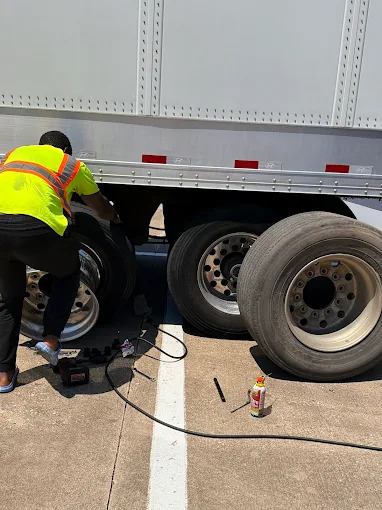
Dallas–Fort Worth sits at the crossroads of some of the busiest freight corridors in the country. I-35 splits into 35E and 35W and funnels traffic north to Denton and south toward Waco and Austin. I-20 runs the southern belt through the industrial corners of the metroplex. I-30 ties Dallas to Fort Worth. When a steer, drive, or trailer tire lets go on any of them, the clock starts immediately — on your delivery window, your hours of service, and your bottom line. This is how professional roadside semi truck tire service keeps a rig moving with the least downtime possible.
Why a highway blowout is a different animal
A passenger flat is an inconvenience. A commercial tire failure on a DFW interstate is a safety event and a business problem at the same time. The rig is heavy, it's often blocking a live shoulder inches from 70-mph traffic, and the driver may be up against a delivery clock or an HOS limit. Trying to limp to the nearest truck stop on a failed drive tire can destroy the casing, damage the wheel, and turn a single-tire fix into a much bigger repair. The right move is to get a qualified tech to the truck — which is exactly what our semi truck tire service does.
Never run on a blown or badly underinflated commercial tire to reach an exit. A failed casing shreds and can take out the wheel, air lines, and fender — and throw debris into traffic. Get the rig safely onto the shoulder, set your triangles, and call for a roadside tech.
Steer, drive, and trailer — every position, DOT in mind
Not all commercial tire positions are equal, and the rules aren't either. A good roadside service treats each position for what it is:
- Steer tires carry the front axle and directly affect handling. Federal regulations hold steer tires to the strictest tread-depth standard, and there are limits on where a repaired tire may be run. We fit steer positions with appropriate, road-legal tires — not whatever happens to be on the truck.
- Drive tires put the power down and take a beating. Matching tread depth and the right load rating across the drive axles matters for traction and even wear.
- Trailer tires take the load and the scrub of tight turns. They're often where a slow leak or a curb cut shows up first.
The goal on every call is a DOT-legal result you can roll into a scale house or an inspection with confidence — the correct size, load range, and condition for the position it's going on.
For a commercial driver, downtime isn't just waiting — it's a missed appointment, a load that ages, and hours you can't get back. The whole point of roadside service is to compress that downtime to the smallest number possible.
How a roadside big-rig call goes
- You call with your location and specs. The interstate and nearest mile marker or exit, the tire position (steer/drive/trailer), and the size and load range if you have it.
- We roll to you with the right tire and tools. Heavy-duty jack, impact tools, and commercial tires or your spare if you're carrying one.
- We change it on the shoulder. Old tire off, new one mounted and torqued to spec, valve and pressure checked.
- You get back in the lane. No tow to a truck shop, no unhitching the trailer to limp somewhere.
If the situation is bigger than a tire — a mechanical failure or a rig that can't safely move — we can also coordinate towing services so you're not stuck making a second round of phone calls from the shoulder.
Where we run
We cover the DFW freight network and the yards, terminals, and truck stops around it. That includes the Fort Worth side — Alliance, the south-side industrial parks, and the I-35W corridor — and the Dallas side along I-20, I-30, I-45, and the LBJ/635 loop. If you're moving freight through North Texas and you're not sure we reach your spot, check our service areas or just call — we'll tell you straight.
Downtime math: shop vs. roadside
| Step | Limp to a Shop | Mobile Roadside |
|---|---|---|
| Getting there | Risk casing/wheel damage or wait on a tow | Tech comes to the rig |
| Time off the road | Travel + shop queue | On-site change only |
| Trailer/load | May need to drop or reroute | Stays hitched |
| After hours | Many shops closed | Open 24/7 |
| Added damage risk | Higher | Lower |
Fleet accounts keep the whole operation moving
If you run more than one truck through DFW, a fleet relationship turns a scramble into a routine. A single number your drivers can call day or night, consistent handling on tire positions, and one point of contact for the paperwork means less time managing breakdowns and more time keeping trucks loaded. Owner-operators get the same straight pricing and fast response — you don't need a hundred trucks to be treated like a priority. To set up an account or ask about coverage, call (682) 392-2068.
What to have ready when you call
- Your exact location — interstate, direction of travel, and nearest mile marker or exit.
- The tire position that failed and how many.
- Tire size and load range if you can read it safely.
- Whether you're carrying a mounted spare.
- Any hazard — leaning trailer, load shift, or a spot with poor shoulder room — so we arrive prepared.
The bottom line
A commercial tire failure on I-35, I-20, or I-30 doesn't have to cost you a load. Get the rig safely stopped, protect the casing and the wheel by not running on it, and call for a roadside tech who can put the right DOT-legal tire on the right position and send you back down the interstate. For 24/7 semi truck and 18-wheeler tire service across Dallas–Fort Worth, call (682) 392-2068.